Preparation for air travel
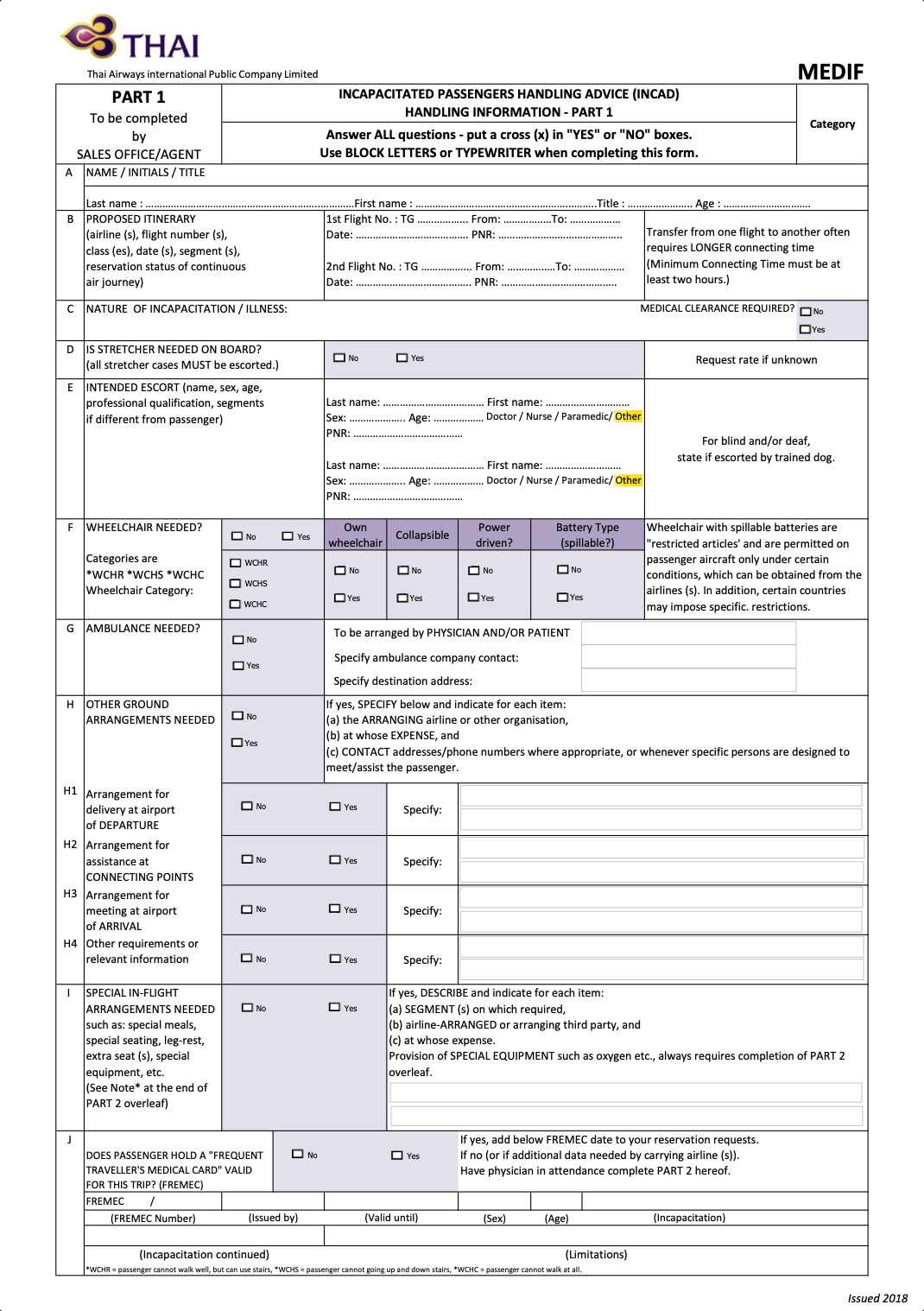
A MEDIF (medical information form) must be filled by your treating doctor to inform the details of the medical condition and if special equipment such as oxygen, a wheelchair or stretcher is required, THAI has the right to refuse, delay or ask to change travel conditions. Travelling by plane is permitted only for treated and stabilized patients.
Advice for Sick Passengers
Sick passengers are sensitive to minor changes, therefore medical consultation before travelling is necessary to minimize health risks. Medications must be kept in the hand luggage. Passengers with medical conditions not treated and stabilized, or passengers with conditions that can be aggravated during flight, must have medical clearance before flight reservation.
Assure sufficient quantities of cardiac medications for the entire trip, including sublingual nitroglycerin, and keep in carry-on luggage. Keep a separate list of medications including dosing intervals and tablet size in the event that medications are lost. Limit unnecessary ambulation, particularly in-flight. The following conditions are not safe for air travel:
Unstable chest pain - Recent myocardial infarction (MI) and congestive heart failure should not fly until at least 6 weeks have passed and they are back to usual daily activities no more chest pain.
Coronary artery bypass grafting (CABG) and other chest surgeries should wait until the air is resorbed 2 weeks before air travel because air is transiently introduced into the chest cavity, there is a risk for barotrauma at decreased atmospheric pressure.
Uncontrolled heart failure.
Untreated hypertension with systolic blood pressure higher than 160 mmHg. No contra-indication to air travel for patients with hypertension as long as it is under reasonable control. Such patients should be reminded to carry their medications onboard.
Untreated arrhythmia (heart rhythm must be controlled and on anti coagulant for travelling).
Decompensated valvular diseases.
Scuba diving less than 24 hours or decompression sickness.
Untreated or unstable pneumothorax.
Undrained pleural effusion.
Asthma, air travel is contra-indicated for those with asthma that is labile, severe, or that has required recent hospitalization. For asthmatics of less severity who are fit to fly, it is imperative that they are reminded to hand-carry on board any vital medication, particularly inhalers for rapid relief of symptoms.
Chronic obstructive pulmonary disease (COPD). Patients with chronic bronchitis, interstitial lung disease and emphysema are susceptible to significant inflight hypoxemia, depending on their baseline PaO2. Preflight evaluation of these patients is ability to walk 50 meters or climb stairs without dyspnea and shortness of breath.
Uncontrolled respiratory failure.
Patient under mechanical ventilation or with the unstable condition for the trip.
Active pulmonary infection.
Neuromuscular diseases with hypoventilation and require a mechanical ventilation.
Pulmonary tuberculosis especially in immunodeficient passengers treated within 2 weeks prior to departure.
Thoracic surgery within 3 weeks prior to departure.
Special precaution for the patients with tracheostomy because of low humidity in the cabin.
Uncontrolled epilepsy or the patients undergone for brain surgery with no complications less than 2 weeks. Normally, the passengers with stable epilepsy or after brain surgery may be more prone to seizures during a long flight, mild hypoxia and hyperventilation are known precipitating factors, in addition to the aggravation of fatigue, anxiety and irregular medication. Whilst it would not be appropriate to change medication immediately prior to a trip, consideration should be given to providing extra anti-convulsive medication. If nothing else, the passengers with epilepsy must ensure that they have sufficient medication in their hand baggage for the duration of the flight and also for any unexpected delays.
Following a stroke or cerebrovascular accident passengers usually have to wait at least 2 weeks before travel if stable or recovering. For those with cerebral artery insufficiency, hypoxia may lead to problems and supplementary oxygen may be advisable.
Patients with accident and brain injury within 15 days prior to departure.
Untreated brain edema or lumbar puncture within 1 week prior to departure.
Patients who have recent brain scan with use of contrast media within 3 days prior to departure.
Psychiatric patients need medical clearance in advance of intended travel. Patients with psychotic disorders who are stabilized on medication and are accompanied by a knowledgeable companion plus suitable sedation may be able to fly.
Passengers may experience abdominal discomfort because of gas expansion in fight.
Patients who have abdominal surgery in which hollow viscus has been sutured are at risk of perforation or haemorrhage as a result of gas expansion at altitude. Air travel should be discouraged for 2 weeks following any abdominal surgical procedure
Travelers with colostomies are not at increased risk during air travel although intestinal distension may increase fecal output. The use of a large colostomy bag is recommended. More frequent changes may be necessary for smaller bags and extra supplies should be carried in the cabin hand baggage.
Patients with intestinal occlusion or with haemorrhage from ulcer sites or rupture of oesophageal varices. For haemorrhage, travel may be permitted if there is clear endoscopic evidence of healing or wait for 3 weeks and haemoglobin level more than 10 g/dl.
Severe gastroenteritis with dehydration.
Patients who have gastric or intestinal surgery in the past 7 days.
Patients who have a colonoscopy in the past 24 hours.
Ophtalmological conditions such as retinal detachment less than 3 weeks, acute glaucoma or recently operations (in the past 1 month), recent cataract surgery, unhealed keratitis, ocular surgery in the past 3 months.
Acute sinusitis or acute otitis.
Ear surgery in the past 3 months.
Severe anaemia with haemoglobin less than 10 g/dl. At low oxygen levels in cabin, passengers may experience lightheadedness or even lose consciousness during flight and haemoglobin less than 8.5 g/dl is contra-indicated for air travel.
Diseases that need medical equipments forbidden by airline regulation.
Transmitted infections : chicken pox, measles, mumps, pertussis, herpes zoster etc.
Immunodeficient patients with severe complications.
Unstable diabetes must not travel by air. For well controlled diabetes, the first step is to order from the airline, in advance, the appropriate diabetic meal. Diabetic travelers should carry all medications (as well as needles, syringes, blood glucose monitors, sugared snacks, and a device to store needles/lances) in carry-on luggage and not in checked luggage. Journeys may across several time zones. It is recommended to remain on departure time during the flight and attempt to readjust to local time on arrival at destinations.
All recent surgery or recent injury, gas trapped within the body will cause problems at altitude.
Recent fracture under plaster cast (cast must be split for traveling to avoid compartment syndrome or harmful swelling on long flight).
Severe burn or infected large wounds.
Terminal stage of illness which can deteriorate during trip.
Precaution for the patients with urinary catheter, balloon must be filled with water, the catheter changed before departure with no sign of urinary tract infection by direct examination and by urine culture.
CONTRAINDICATION conditions
Infants less than 7 days of age, the cabin atmosphere can cause problem for newborns. MEDIF is needed for premature babies.
Pregnant women: non complicated pregnancy is accepted on board; the conditions depend on the airlines to prevent premature labor on board; caution should be exercised about frequent flying during early weeks because of hypoxia. The conditions for pregnant women are as follows
Pregnancy more than 28 weeks must have a medical certificate confirming the date of delivery and conditions of pregnancy.
Single pregnancy can travel until 36th week for flight durations less than 4 hours and 34th weeks for the flight duration more than 4 hours. The medical certificate with estimate date of delivery and confirmation of a normal pregnancy is needed.
Multiple or complicated pregnancy (placenta previa, past history of premature delivery etc.) are relatively contraindicated for travelling long distance by air, the medical approval from the company is absolutely needed.
Pregnancy more than 36 weeks is an absolute contraindication for travelling by air.